Choosing the Perfect Exterior Color for Arizona
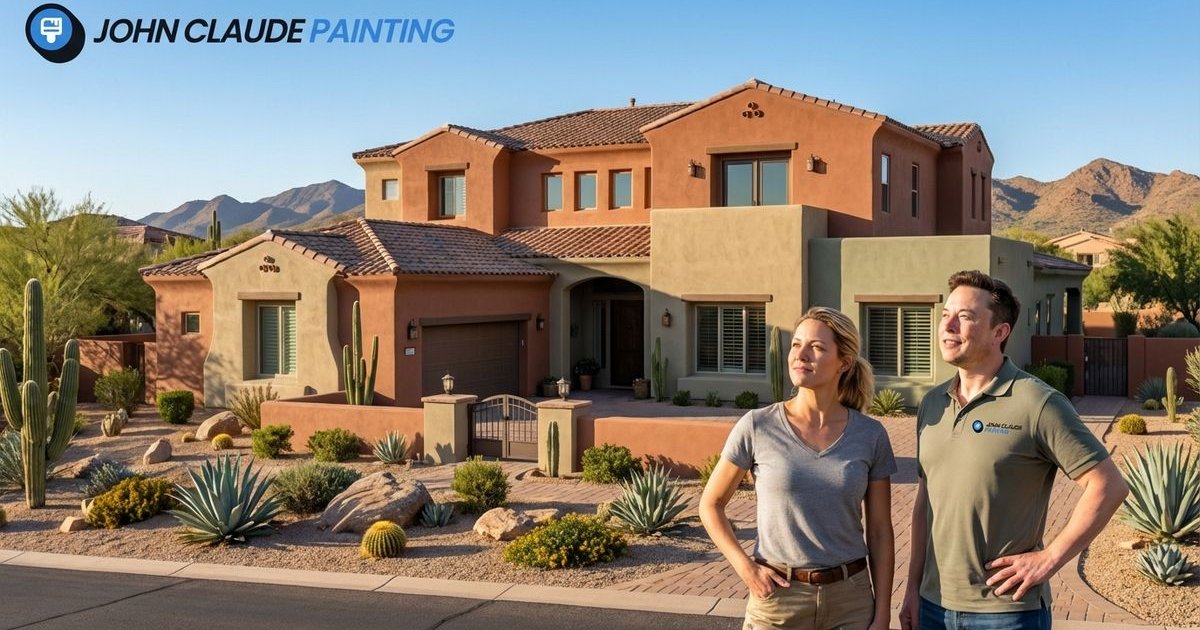
You know that specific, blinding glare that comes off a neighbor’s house during a Phoenix summer afternoon? That is exactly what happens when you pick a paint color without accounting for our intense desert light. The sun here does not just illuminate your home. It actively tests the limits of your exterior’s durability every single day.
At John Claude Painting, we see firsthand through our exterior painting projects how the Arizona environment treats different pigments. A shade that looks charming in a magazine often looks completely washed out or oddly neon under our bright blue sky.
This guide shares the specific formulas and color families that actually hold up in the Metro-Phoenix area.
Arizona Color Challenges
Before you look at swatches, you need to understand the science of what our climate does to chemical pigments. The desert environment presents three distinct threats to your home’s exterior shell.
Sun Exposure and Thermal Shock
Phoenix averages more than 3,800 hours of sunshine per year. This constant UV exposure does more than just fade color.
The impact of heat accumulation:
- Surface Temperatures: A dark-colored stucco wall can reach temperatures exceeding 160°F in July.
- Thermal Shock: Your exterior expands during the day and contracts rapidly at night.
- The Consequence: This daily movement causes hairline cracks in stucco, leading to moisture intrusion during monsoon season.
- Energy Efficiency: Lighter colors with a Light Reflective Value (LRV) above 50 reflect heat and help keep your attic cooler.
Dust and The “Haze” Factor
Our local dust has a very specific beige-taupe quality.
How dust affects perception:
- High Contrast Issues: Bright white homes show every speck of settled dust after a haboob.
- Dark Haze: Deep charcoal or navy bodies will appear to have a permanent, chalky film on them.
- The Sweet Spot: Mid-tone neutrals act as camouflage. They allow your home to look clean even when it has been weeks since the last rain.
The Desert Backdrop
Your home needs to sit naturally within the Sonoran palette.
- Geological Harmony: Our landscape is filled with reddish iron oxides, sage greens, and sandy browns.
- Light Quality: The sunlight here is warm and yellow-toned.
- Color Shift: Cool grays often turn surprisingly blue or purple once they are on a large wall in Chandler or Gilbert.
Top Color Families for Arizona Homes
We have analyzed the performance of countless gallons of paint across the East Valley. These specific families consistently offer the best balance of longevity and curb appeal.
Warm Neutrals (The Gold Standard)
These shades are the backbone of Phoenix residential architecture for a reason. They bridge the gap between traditional stucco styles and modern preferences.
Top Performers (Sherwin-Williams):
- Accessible Beige (SW 7036): A versatile neutral that avoids pink undertones.
- Balanced Beige (SW 7037): Slightly darker, offering better UV protection.
- Kilim Beige (SW 6106): Removes the “yellow” look common in older tans.
- Canvas Tan (SW 7531): A light, airy option that feels fresh but not blinding.
Why these excel: Warm neutrals contain enough yellow and red oxide pigments to resist UV fading better than organic cool colors. They also typically fall into the “safe” LRV range of 40-60.
Desert Earth Tones
If you want your home to feel anchored to the ground, look at these richer, deeper hues.
Top Performers:
- Toasty (SW 6095): A rich, warm brown that holds its depth.
- Pottery (SW 0048): Captures the terracotta look without being orange.
- Territorial Beige (SW 7700): The classic choice for Santa Barbara style homes.
- Pueblo (SW 7706): A softer clay tone that glows at sunset.
Why these excel: These darker earth tones are incredibly forgiving with dust. They also provide excellent contrast against green xeriscaping plants like agave or palo verde trees.
Modern Warm Grays
Pure gray often looks out of place in the desert, but “greige” (gray-beige) is a top request from our clients in Ahwatukee and Scottsdale.
Top Performers:
- Agreeable Gray (SW 7029): The number one selling paint color for a reason.
- Mindful Gray (SW 7016): Offers enough depth to not wash out in full noon sun.
- Intellectual Gray (SW 7045): Has a subtle green undertone that works well with desert plants.
- Dorian Gray (SW 7017): A medium tone that pairs perfectly with white trim.
Comparison of Gray Performance:
| Feature | Cool Grays | Warm Grays (Greige) |
|---|---|---|
| Undertone | Blue/Purple | Brown/Tan |
| Sunlight Effect | Looks “icy” or synthetic | Looks natural and inviting |
| Landscape Match | Clashes with red rocks | Harmonizes with stone/sand |
| Popularity | Declining in AZ | Rising rapidly |
Sophisticated Taupes
Taupe brings a level of elegance that standard beige cannot match.
Top Performers:
- Mega Greige (SW 7031): A bold choice that commands attention.
- Virtual Taupe (SW 7039): Deep, rich, and very popular for accents or fascia.
- Keystone Gray (SW 7504): Reads as a true stone color.
- Sticks and Stones (SW 7503): A moody, modern option for contemporary builds.
HOA-Approved Color Strategies
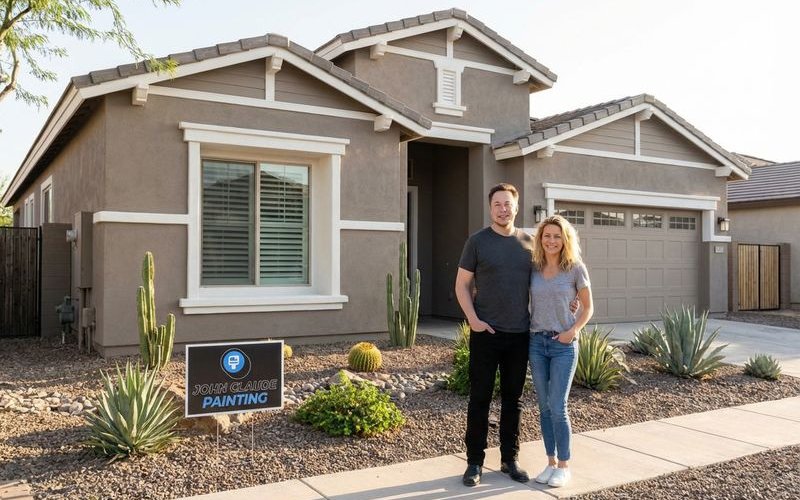
Dealing with Homeowners Associations in Gilbert, Chandler, and Mesa is a major part of our daily work. We know that a rejected color scheme costs you time and money.
Understanding the “LRV” Rule
Many HOAs specifically regulate Light Reflective Value (LRV).
The LRV constraints:
- What it is: A measurement of how much light a color reflects (0 is black, 100 is white).
- Common Limit: Many associations prohibit body colors with an LRV higher than 85 (too bright) or lower than 20 (too dark).
- The Trap: A “white” house usually needs to be an off-white (LRV 70-82) to pass committee review.
Insider Tips for Fast Approval
Success strategies:
- Check the “Schemes”: Most communities like Seville or Power Ranch have pre-set binder schemes. Sticking to these guarantees approval.
- Photograph Your Neighbors: Committees often reject colors that are identical to the immediate next-door neighbor.
- Submit Physical Chips: Digital screenshots look different on every screen. We always provide physical chips for your submission to avoid confusion.
- Define Your Trim: Explicitly state which color is for the “pop-out” stucco versus the wood fascia.
Colors That Always Pass
You can almost certainly rely on these combinations to get a “yes” from the board:
- Body: Mid-tone tans (LRV 40-60) like Latte or Nomadic Desert.
- Trim: Soft creams (LRV 75-85) rather than stark bright whites.
- Garage: Matching the body color is the safest bet to avoid visual clutter.
Trim and Accent Considerations
The trim is where you frame the picture. In Arizona, the material of your trim dictates your color choice just as much as your aesthetic preference does.
Trim Colors That Work
Classic White (High Contrast):
- Snowbound (SW 7004): Clean but not clinical.
- Greek Villa (SW 7551): Soft and warm, excellent for Spanish styles.
- Alabaster (SW 7008): Creamy enough to not glare, bright enough to pop.
Warm Cream (Subtle):
- Dover White (SW 6385): A historic favorite for traditional homes.
- Creamy (SW 7012): Yellow-based, pairs well with brown roof tiles.
- Antique White (SW 6119): Deep enough to act as a body color on some interiors, but a great exterior trim.
Dark Contrast (Modern):
- Urbane Bronze (SW 7048): The go-to “black” that is actually a deep bronze-brown.
- Black Fox (SW 7020): A rich chocolate-black.
- Ripe Olive (SW 6209): A stunning deep green that fits the desert flora.
The Material Warning
Vinyl Window Caution: We strongly advise against painting vinyl window frames with dark colors like Black or Urbane Bronze. Dark paint absorbs heat, which can warp the vinyl frames and ruin the seal of your dual-pane windows.
The Front Door Factor
This is your opportunity to add personality without painting the whole house.
Top Arizona door trends 2026:
- Iron Ore (SW 7069): A soft black that looks like wrought iron.
- Copper Mountain (SW 2834): Mimics real copper accents.
- Quietude (SW 6212): A muted teal that works with terracotta.
Colors to Avoid
Certain pigments simply cannot handle the Arizona UV index.
High-Fade Risk
Organic Pigments: Colors derived from organic compounds break down faster under UV radiation.
- Bright Reds: Turn pink or chalky within 2-3 years.
- Vibrant Yellows: Fade to a pale, patchy white.
- Deep Blues: Often bleach out to a hazy gray.
The “Stark White” Mistake
Why pure white fails:
- Glare: It is physically painful to look at a pure white house (LRV 90+) in direct Phoenix sun.
- Dirt Magnet: The red desert dust settles on stucco ledges, creating visible orange lines against the white paint.
- HOA Rejection: Many committees will flat-out deny “High Reflective White.”
Cool-Toned Colors
The “Blue House” Phenomenon: A gray swatch that looks perfect in the store will reflect the massive blue sky once applied to your exterior walls. This often results in a house that looks baby blue rather than sophisticated gray. We always recommend choosing a gray that looks “muddy” or “brown” on the chip to get a true gray read on the wall.
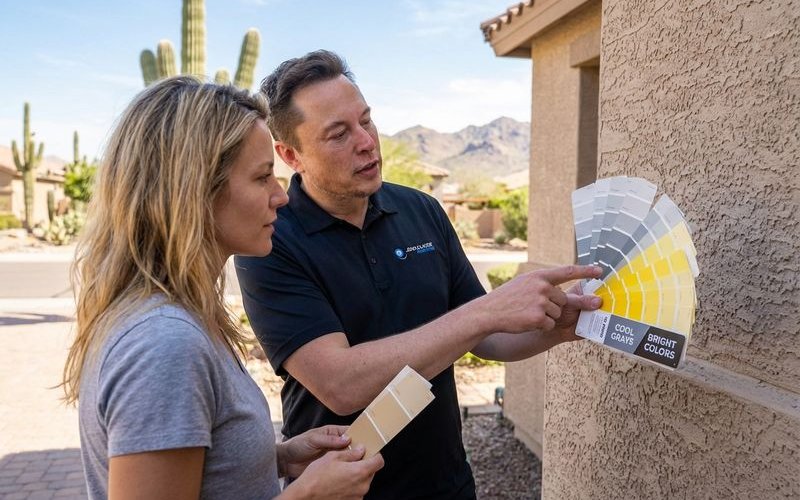
Testing Colors Before Committing
You should never trust a 2-inch paper chip to make a decision for your entire home.
The 4x4 Rule
Proper sampling method:
- Buy a quart: Do not rely on the small peel-and-stick samples for stucco.
- Paint a large square: Cover a 4-foot by 4-foot section of your actual exterior wall.
- Two Coats: You need full saturation to see the true color depth.
Consider Light Changes
Arizona light shifts dramatically throughout the day.
Watch your sample during these times:
- 8:00 AM (East Side): Direct, cool light.
- 12:00 PM (Full Sun): High intensity, washes out color saturation.
- 5:00 PM (Golden Hour): Adds a heavy yellow/orange cast to everything.
Working With Professionals
A professional painter does more than just apply coating. We act as your durability consultants.
Color Consultation Benefits
What we analyze:
- Substrate Condition: Is your stucco thirsty? It might darken the paint color.
- Roof Color: We ensure your paint does not clash with your red clay or gray concrete tiles.
- Fixed Elements: We coordinate with your stone veneer and paver driveway.
What We Provide
At John Claude Painting, our process is designed to remove the guesswork.
Our commitment:
- Custom Match: We can match faded colors if you only need a touch-up.
- HOA Packets: We help gather the codes and names you need for your application.
- Premium Materials: We use 100% acrylic paints like Sherwin-Williams specifically formulated for high-UV environments.
Popular Color Combinations
If you want a fail-safe palette, these combinations are proven winners in the Valley.
Classic Arizona
- Body: Accessible Beige (SW 7036)
- Trim: Snowbound (SW 7004)
- Accents: Ripe Olive (SW 6209)
- Vibe: Timeless, clean, and HOA-friendly.
Modern Desert
- Body: Agreeable Gray (SW 7029)
- Trim: Pure White (SW 7005)
- Accents: Iron Ore (SW 7069)
- Vibe: Crisp, high-contrast, and contemporary.
Warm Traditional
- Body: Kilim Beige (SW 6106)
- Trim: Dover White (SW 6385)
- Accents: Roycroft Suede (SW 2842)
- Vibe: Inviting, established, and warm.
Contemporary Southwest
- Body: Mega Greige (SW 7031)
- Trim: Alabaster (SW 7008)
- Accents: Tiki Hut (SW 7509)
- Vibe: Sophisticated and grounded.
Ready to Transform Your Home?
The right paint job protects your biggest investment from the harshest elements. At John Claude Painting, we combine technical knowledge of paint chemistry with a deep appreciation for Arizona’s unique aesthetic.
Call us at 602-572-1234 or request a consultation to secure your spot on our schedule. We proudly serve Phoenix, Chandler, Gilbert, Mesa, Tempe, Scottsdale, and the entire East Valley.
Not sure which colors to choose? Ask about adding our professional color consultation service to your painting estimate.