Two Different Worlds of Painting
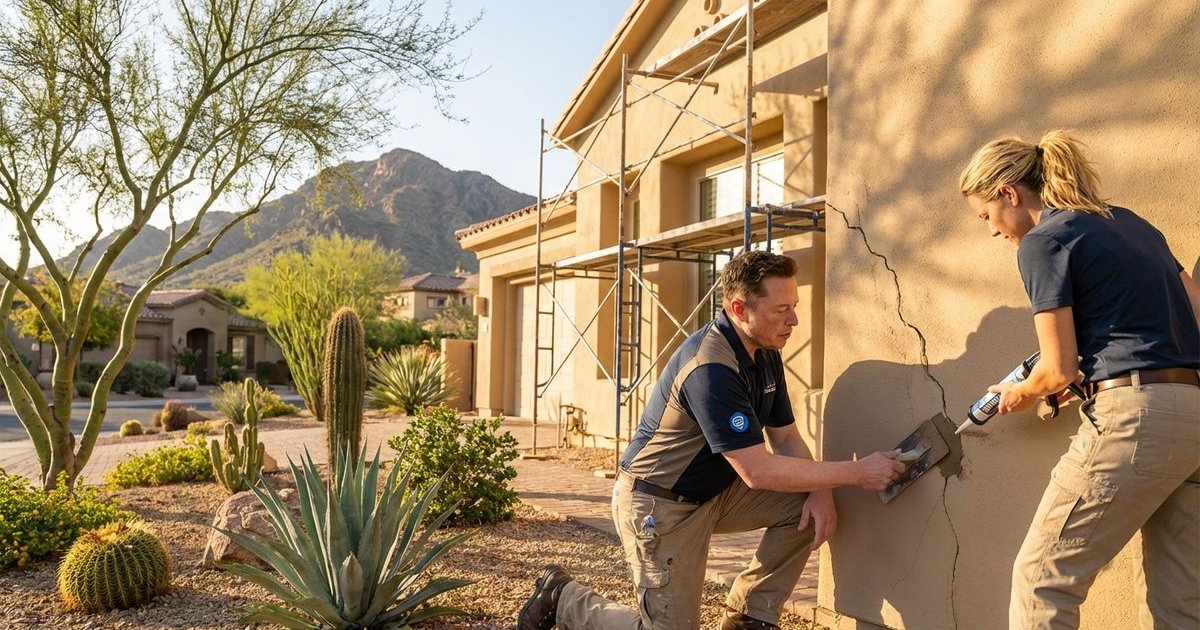
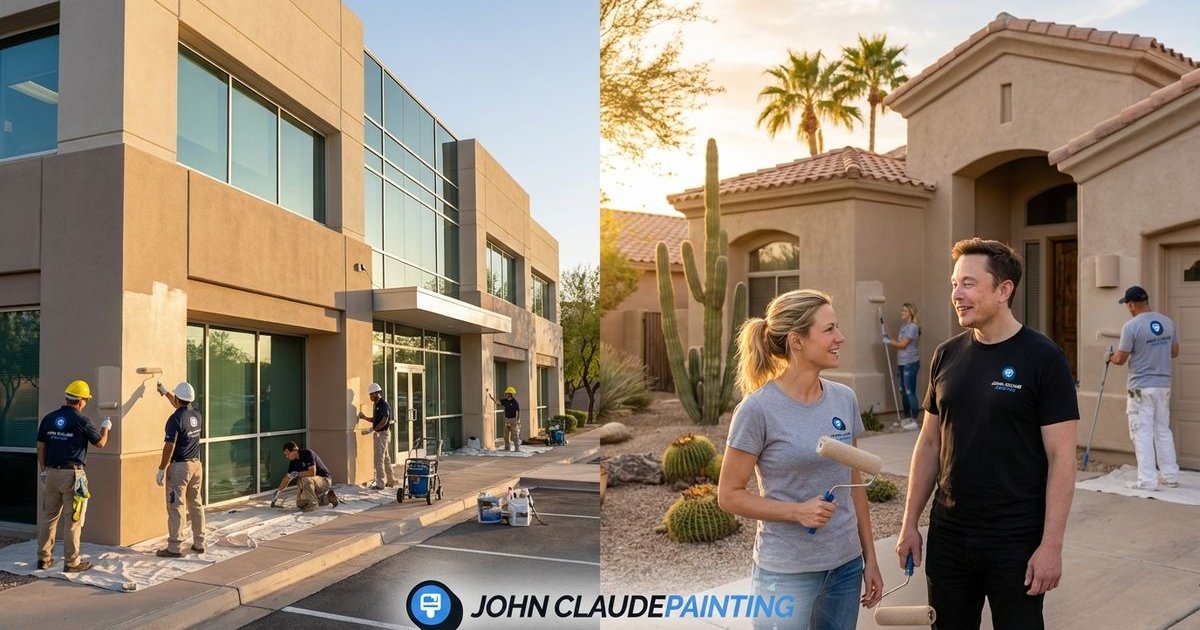
You know how some people assume painting is just rolling color onto a wall regardless of the building type? From our experience, that misconception often leads to budget overruns and disappointing results. The reality is that commercial and residential painting are two entirely separate disciplines, each with its own set of rules, materials, and challenges.
At John Claude Painting, we handle both commercial painting and residential projects throughout Phoenix. Understanding these distinctions is the best way to protect your investment and ensure the job gets done right the first time.
Scale and Scope Differences
The most immediate difference between these two sectors is the sheer magnitude and complexity of the work environment.
Residential Projects
Typical scope:
- Single-family homes in areas like Ahwatukee or Gilbert
- Individual rooms or whole-house interiors
- Average sizes ranging from 1,500 to 5,000 sq ft
- Personal living spaces
Characteristics:
- Intimate scale: We focus heavily on protecting your personal belongings and daily routine.
- Detailed precision: Homeowners often scrutinize walls from a distance of 12 inches or less.
- Furniture management: Moving and covering sofas, heirlooms, and electronics is part of the job.
- Personalized scheduling: Work hours are adjusted to accommodate family life, often starting after the kids leave for school.
Commercial Projects
Typical scope:
- Office buildings and corporate parks
- Retail stores and shopping centers
- Restaurants and hospitality venues
- Warehouses and industrial facilities
- Multi-unit properties
Characteristics:
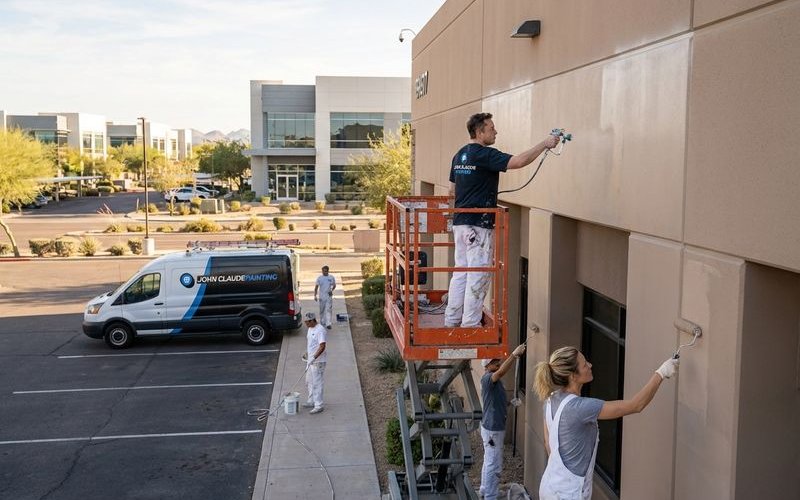
- Volume-focused: Commercial jobs often involve tens of thousands of square feet of wall space.
- Operational continuity: The primary goal is often to maintain business operations while work proceeds.
- Height and access: Ceilings frequently exceed 10 feet, requiring specialized lifts rather than standard ladders.
- Speed and efficiency: Crews are scaled up to complete large sections rapidly to minimize downtime.
Paint Products and Materials
The chemistry of the paint we use changes drastically depending on the building’s function.
Residential Paint Priorities
We prioritize aesthetics and health for interior living spaces.
Focus on:
- Visual depth: Products like Sherwin-Williams Emerald or Dunn-Edwards Everest offer superior color retention and finish.
- Washability: Families need finishes (like satins or semi-glosses) that can withstand scrubbing without losing sheen.
- Safety: Low or zero VOC (Volatile Organic Compounds) formulas are essential for maintaining healthy indoor air quality.
- Touch-up capability: The ability to seamlessly blend a repair later is a key selection factor.
Common products:
- Premium latex acrylics
- Urethane-fortified enamels for cabinets
- Stain-blocking primers
- Decorative glazes
Commercial Paint Priorities
Performance and longevity under stress drive these product choices.
Focus on:
- Extreme durability: Commercial coatings must withstand impact, frequent chemical cleaning, and high traffic.
- Cost-efficiency: High-build coatings that cover large areas in fewer coats are preferred to manage labor costs.
- Regulatory compliance: Products often need to meet specific fire ratings or LEED certification standards.
- Rapid curing: Fast-drying formulas allow businesses to reopen areas within hours, not days.
Common products:
- Two-part epoxies for floors and high-traffic walls
- Dryfall paints for industrial ceilings (paint turns to dust before hitting the floor)
- Direct-to-Metal (DTM) acrylics
- Anti-graffiti coatings
Specialty Requirements
Certain commercial environments in the Valley require highly specialized chemical formulations.
| Setting | Special Requirements | Key Product Feature |
|---|---|---|
| Healthcare | Anti-microbial, Zero VOC | Prevents bacterial growth and protects patients |
| Food Service | FDA-compliant, moisture-resistant | Withstands harsh degreasers and daily steam cleaning |
| Educational | Scuff-resistant, easily cleaned | Resists marks from bags, shoes, and equipment |
| Industrial | Chemical-resistant, high-durability | Protects substrates from corrosive spills |
| Retail | Aesthetic durability | Maintains brand colors under harsh lighting |
Scheduling and Timing
Logistics are often the most stressful part of a project, so we approach them differently depending on the client.
Residential Scheduling
Considerations:
- Respecting family privacy and sleep schedules
- Typically working standard hours (8 AM to 4 PM)
- Adjusting for Phoenix heat on exterior projects (starting earlier in summer)
- Room-by-room sequencing to leave the house livable
Typical timeline:
- Single room: 1-2 days
- Whole interior: 3-7 days
- Exterior: 3-7 days depending on prep needs
Commercial Scheduling
Considerations:
- Strict “Return to Service” deadlines
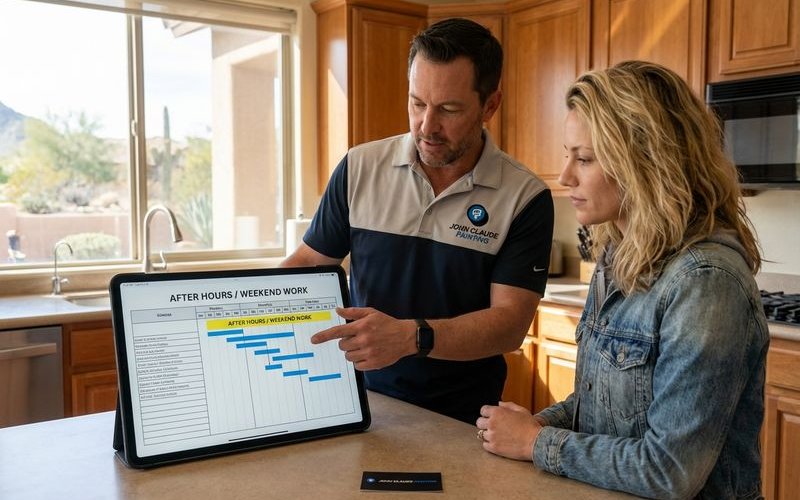
- After-hours, overnight, or weekend shifts to avoid disrupting customers
- Phased blocking to keep sections of the business open
- Coordination with other trades (electricians, flooring installers)
Typical timeline:
- Project dependent: Timelines are dictated by business needs rather than crew convenience.
- Compressed schedules: We often deploy larger crews to finish a month’s worth of work in a week.
- Holiday shutdowns: Major industrial work often happens during plant closures.
Equipment and Resources
The tools you see on the job site tell you immediately what kind of project it is.
Residential Equipment
Standard needs:
- Extension ladders and 6-foot step ladders
- 9-inch rollers and fine-finish brushes
- Small airless sprayers (like a Titan 440) for trim or doors
- Rosin paper and plastic sheeting for furniture
Crew size:
- Small teams: Usually 2-3 painters to maintain a low profile in your home.
- Consistency: Homeowners prefer seeing the same faces every day for security and comfort.
Commercial Equipment
Often required:
- Heavy machinery: Boom lifts and scissor lifts (JLG or Genie) are standard for reaching high warehouses or exterior signage.
- High-volume sprayers: Industrial rigs capable of pushing thicker coatings through long hoses.
- Commercial blasting: Pressure washers with PSI ratings over 4,000 for surface prep.
- Safety barriers: extensive signage and cones to redirect foot traffic.
Crew size:
- Scalable workforce: Projects may require 10+ painters working simultaneously.
- Shift rotation: Crews may swap out to keep the project moving 24 hours a day.
Preparation Differences
A paint job is only as good as the surface underneath it.
Residential Prep
Focus areas:
- Filling minor nail holes and hairline cracks
- Caulking baseboards for a seamless look
- Protecting hardwood floors and carpets
- Sanding trim for perfect adhesion
Approach:
- Surgical precision: We treat the home like a museum, covering everything that isn’t being painted.
- Dust management: Using HEPA-filtered sanders keeps your air clean.
- Detail-oriented: The goal is a flawless finish that looks good from inches away.
Commercial Prep
Focus areas:
- Removing industrial grease or manufacturing residue
- Repairing damage from forklifts or carts
- Sandblasting steel structures
- Protecting inventory and sensitive machinery
Approach:
- Aggressive cleaning: Industrial degreasers and power washing are often the first steps.
- Broad coverage: Large plastic curtains isolate work zones from active business areas.
- Speed: Prep is thorough but designed to get to the coating stage quickly.
Pricing Structures
Understanding the bid helps you compare apples to apples.
Residential Pricing
Common methods:
- Lump sum: A fixed price for the entire scope.
- Per room: Easy for homeowners to understand and budget for.
- Detail-driven: Higher costs for intricate trim work, vaulted ceilings, or multiple colors.
Factors:
- Level of prep required (Level 4 vs Level 5 finish)
- Furniture manipulation needs
- Premium paint selection cost
Commercial Pricing
Common methods:
- Square footage rates: Common for large, open wall spaces.
- Linear foot pricing: Often used for baseboards or safety striping.
- Time and Materials (T&M): Used for unpredictable scopes or repair work.
Factors:
- Economies of scale: The cost per square foot often drops as the project size increases.
- Access difficulty: High-reach work increases insurance and equipment costs.
- Shift premiums: Night and weekend work may carry a labor surcharge.
Relationship Dynamics
We tailor our communication style to match the priorities of the person hiring us.
Residential Clients
Typically:
- Homeowners making personal investment decisions
- Families concerned about safety and aesthetics
- Clients looking for guidance on color trends
Expectations:
- Education: We spend time explaining the difference between flat, eggshell, and satin sheens.
- Trust: You are inviting us into your private sanctuary.
- Visualization: Color fan decks and samples are a major part of the pre-work process.
Commercial Clients
Typically:
- General Contractors (GCs)
- Property Managers
- Facility Directors
- HOA Boards
Expectations:
- Documentation: Certificates of Insurance (COI) and W-9s must be submitted immediately.
- Compliance: Adherence to strict contracts and payment terms (often Net 30 or Net 60).
- Reporting: Daily logs and progress photos are often required.
Regulatory and Compliance Differences
Skipping these rules can lead to massive fines, especially in commercial settings.
Residential
Typical requirements:
- HOA Guidelines: Especially in Master Planned Communities like those in Chandler, exterior colors must match approved palettes.
- EPA RRP Rule: Strict lead-safe practices are mandatory for homes built before 1978.
- Noise ordinances: Work is generally restricted to daytime hours.
Commercial
Common requirements:
- OSHA Standards: Strict adherence to 1910 (General Industry) and 1926 (Construction) safety codes is non-negotiable.
- ADA Compliance: Painting accessible parking zones and safety curbing requires precise color and measurement adherence.
- Fire Codes: Using intumescent (fire-retardant) coatings on steel structures.
- Insurance limits: Commercial policies often require $2 million in aggregate liability coverage or more.
Choosing the Right Contractor
Hiring a residential painter for a warehouse—or a commercial crew for a heritage home—is usually a mistake.
For Residential Projects
Look for:
- A portfolio of local homes similar to yours
- Current license with the Arizona Registrar of Contractors (ROC)
- Clear communication about protecting your furniture
- Willingness to provide color samples
Ask about:
- “Will the same crew be here every day?”
- “What is your daily cleanup process?”
- “Do you offer a warranty on peeling or blistering?”
For Commercial Projects
Look for:
- Proof of commercial-grade insurance and bonding
- Experience with industrial coatings and machinery
- Sufficient manpower to hit tight deadlines
- Safety records and OSHA certifications
Ask about:
- “Can you staff night shifts or weekends?”
- “What is your experience modification rating (EMR) for safety?”
- “Do you own your lifts, or do you rent them?”
Our Approach to Both
At John Claude Painting, we have distinct divisions to ensure every project gets the specialized attention it needs.
Residential Strengths
We bring a “white glove” service mentality to your home.
- Respect: Technicians are trained to treat your property with absolute care.
- Cleanliness: Daily site cleanup is mandatory, not optional.
- Consultation: We help you navigate the thousands of colors available to find the perfect match.
Commercial Capabilities
Our commercial division operates with military-like precision.
- Capacity: We have the resources to scale up for large facility shutdowns.
- Technical expertise: Our team is certified in applying high-performance industrial coatings.
- Flexibility: Your business hours dictate our work schedule, not the other way around.
The Right Contractor for Your Project
The success of your painting project relies entirely on matching the contractor’s skills to your specific needs.
For residential projects: You need a partner who values craftsmanship, patience, and the safety of your home environment above all else.
For commercial projects: You require a strategic partner who understands ROI, minimizes liability, and delivers industrial-grade durability.
Ready to Start Your Project?
At John Claude Painting, we combine technical expertise with local market knowledge to deliver superior results for both homeowners and businesses across the Valley.
Call us at 602-572-1234 or contact us online to discuss your painting project. We serve Phoenix, Chandler, Gilbert, Mesa, Tempe, Scottsdale, and the East Valley.
Not sure what type of service you need? Contact us for a consultation. We’ll assess your project and explain exactly how we’d approach it for the best results.