Planning Your Cabinet Painting Timeline
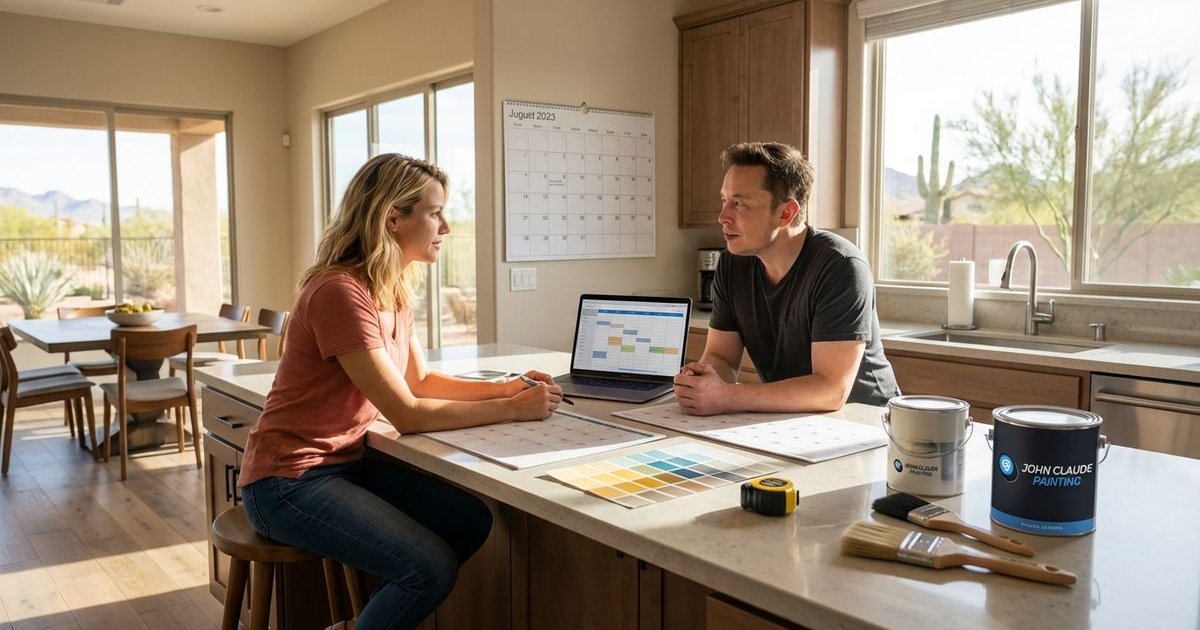
You likely have one big worry on your mind regarding this project. Most homeowners in the Phoenix area immediately ask us how long they will be locked out of their own kitchen.
At John Claude Painting, we understand that losing access to your cooking space is a major inconvenience. Minimizing this disruption is a core part of our cabinet painting process.
We have refined a specific system that balances speed with the curing time necessary for a durable finish. This guide outlines the realistic schedule you can expect for a professional grade finish.
Total Project Timeline
Estimating the duration requires looking at the sheer volume of cabinetry. A standard tract home in Chandler differs significantly from a custom build in Ahwatukee.
Our data from hundreds of local projects provides these average completion times for our off-site spray method:
| Project Scale | Door/Drawer Count | Typical Duration |
|---|---|---|
| Standard Kitchen | 15-20 pieces | 4-5 Working Days |
| Medium Kitchen | 20-30 pieces | 5-7 Working Days |
| Large Kitchen | 30-45 pieces | 7-10 Working Days |
| Estate Kitchen | 45+ pieces | 10-14 Working Days |
These estimates cover the entire scope from the initial masking to the final hardware adjustment.
Day-by-Day Breakdown
Understanding the daily workflow helps you plan your meals and home life. The following schedule illustrates a typical medium-sized project.
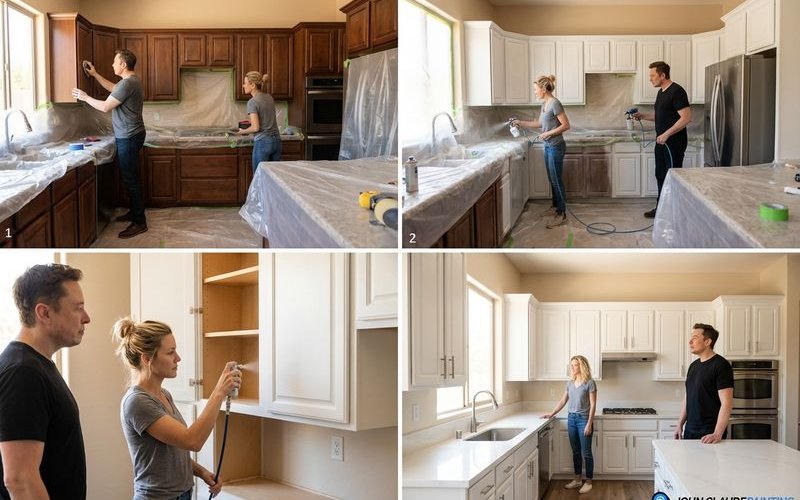
Day 1: Removal and Site Protection
Morning (2-4 hours) We start by turning your kitchen into a protected workspace.
- Floors are covered with heavy-duty builder’s board or rosin paper.
- Countertops receive a layer of protective plastic and masking.
- Doors and drawer fronts are removed and cataloged using a numbered system.
- Hinges and hardware are removed and stored in labeled bags.
Afternoon (2-3 hours) Our team shifts focus to the permanent elements of your kitchen.
- Cabinet frames remaining on the walls are degreased using industrial cleaners like TSP substitutes.
- Any existing damage or nail holes in the frames are filled.
- Surfaces are scuff-sanded to create a mechanical bond for the primer.
- Doors are loaded and transported to our climate-controlled spray facility.
Your kitchen status: The skeleton of your cabinets remains. You can access your fridge and pantry, but the doors are gone.
Days 2-3: The Off-Site Spray Process
While your home remains relatively quiet, the heavy lifting happens at our shop.
At the facility We utilize industrial wood coatings that require specific application conditions.
- Doors undergo a deep cleaning to remove years of cooking oils.
- Two coats of bonding primer are applied to block tannins.
- Surfaces are sanded between every single coat for a glass-smooth feel.
- Topcoats are applied using air-assisted airless sprayers for a factory finish.
- Racks are used to allow pieces to dry flat, preventing runs or sags.
Your kitchen status: You have full use of the room. Our team may return briefly to prep or prime the frame boxes, but noise is minimal.
Day 4 (or 5): Frame Painting
On-site work (4-6 hours) We return to your home to match the frames to your doors.
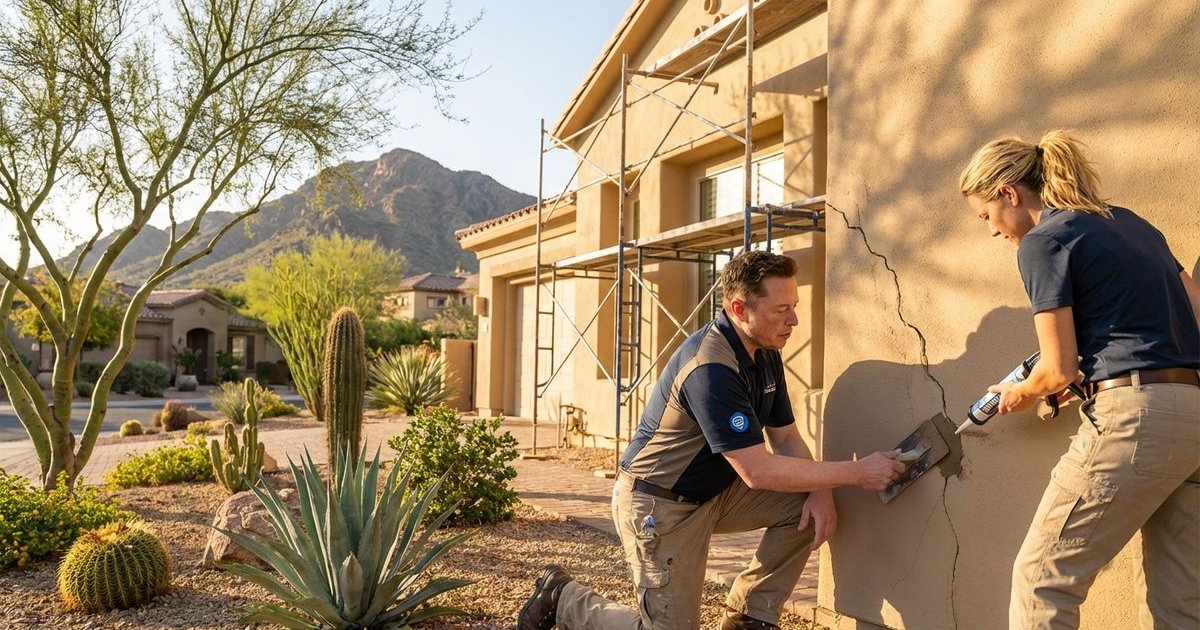
- Surrounding areas are masked off with plastic “zip walls” to contain any overspray.
- Primer and topcoats are applied to the fixed cabinet boxes.
- High-velocity fans may be used to circulate air and aid drying.
- Masking materials are removed once the paint is dry to the touch.
Your kitchen status: This is the one day of limited access. We recommend planning a dinner out or ordering delivery.
Day 5-7: Reinstallation and Handoff
Final day (4-6 hours) We bring the finished doors back to your home for the transformation.
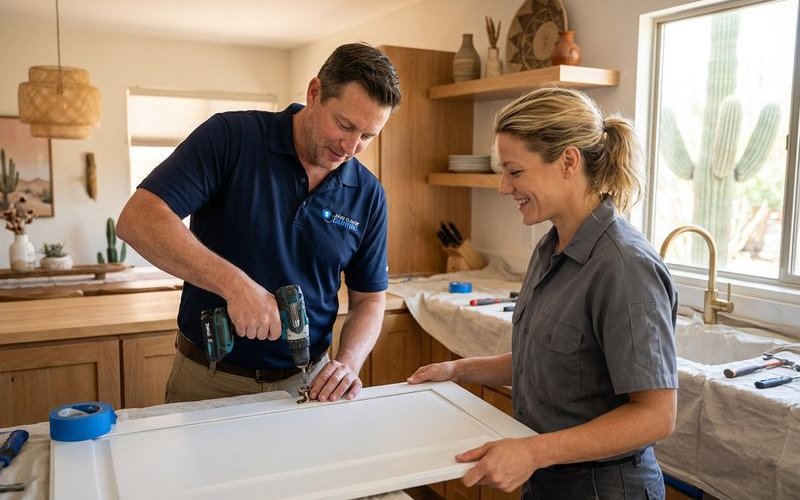
- Doors and drawer fronts are re-hung using the original numbered system.
- Hinges are adjusted so every gap is even and doors hang straight.
- New rubber bumpers are installed for soft closing.
- A final visual inspection ensures no spot was missed.
- We walk through the project with you to ensure total satisfaction.
Your kitchen status: Fully operational. You can start restocking your shelves immediately.
Factors That Affect Timeline
Every kitchen has unique characteristics that can shift the schedule. Identifying these variables early prevents surprises later.
1. Significant Color Changes
Going from a dark espresso stain to a stark white requires aggressive priming.
- Bleed-Through Risk: Dark wood tannins try to escape through light paint.
- Solution: We apply extra coats of stain-blocking primer.
- Time Impact: This adds 1-2 days for additional drying and sanding steps.
2. The “Honey Oak” Factor
Many homes in Gilbert and Mesa built in the 1990s feature oak cabinets with deep wood grain.
- The Issue: Paint alone will not hide the texture of open grain.
- The Fix: We must hand-trowel a grain filler paste over every inch of surface.
- Time Impact: This labor-intensive process adds 2-3 days to the timeline.
3. Weather and Humidity
The intense Phoenix climate plays a distinct role in how chemical coatings cure.
- Dry Heat: Extremely low humidity (under 15%) can cause paint to dry too fast, leading to a rough texture.
- Monsoons: High humidity during summer storms can double the time needed between coats.
- Control: Our shop environment mitigates this, but on-site frame painting is subject to the weather.
4. Cabinet Complexity
Standard shaker doors are quick to prep and spray.
- Detail Work: French provincial or raised panel doors have more crevices.
- Glazing: Adding a decorative glaze requires hand-wiping every door.
- Time Impact: Intricate styles or specialty finishes generally add 2-4 days.
What About On-Site Spraying?
You might find contractors who promise a 3-day turnaround by spraying everything inside your house. We advise caution with this approach.
Comparison of professional methods:
| Feature | Off-Site Shop Method | On-Site Spray Method |
|---|---|---|
| Timeline | 5-7 Days | 3-5 Days |
| Fumes/Odor | Minimal (Most stays at shop) | High (Concentrated in home) |
| Kitchen Access | Available most days | Sealed off completely |
| Finish Quality | Factory-grade smooth | Prone to dust/debris |
The Trade-Offs
Pros of On-Site:
- Faster completion.
- Lower labor costs for transport.
Cons of On-Site:
- Your entire kitchen must be sealed in a plastic bubble.
- HVAC systems often need to be turned off to prevent dust circulation.
- Hazardous Fumes: Industrial coatings like 2K Polyurethanes contain isocyanates, which are unsafe to breathe without fresh air supply.
We prioritize the off-site method. It yields a superior furniture-grade finish and keeps hazardous fumes out of your living space.
Minimizing Kitchen Disruption
Living without a kitchen requires a bit of strategy. A little preparation makes the week fly by.
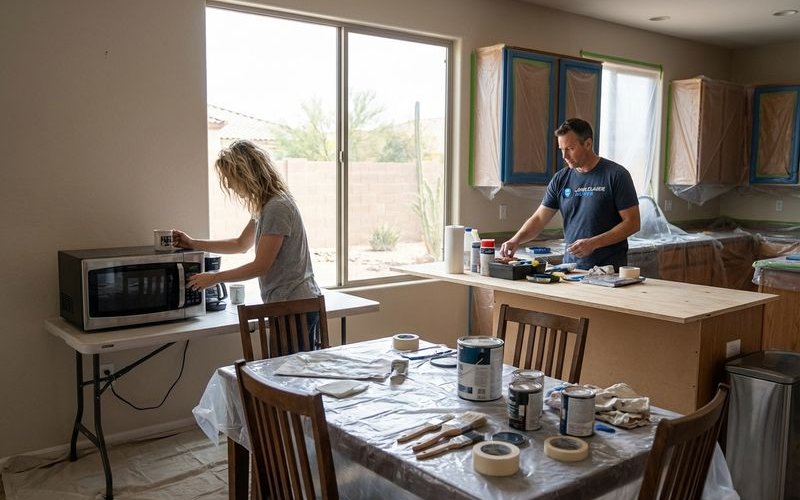
Create a Temporary Kitchenette
Set up a satellite station. Move a table into the dining room or living area to serve as your hub.
- Relocate the microwave, toaster oven, and coffee maker.
- Stock a cooler with milk, sandwich meat, and drinks if the fridge is blocked (rarely happens with our method).
- Use disposable plates and cutlery to avoid washing dishes in a bathroom sink.
Menu Planning
Think “camp style” cooking. Your stove will likely be off-limits for safety during masking.
- Utilize slow cookers or Instant Pots in your temporary zone.
- Grill outside if the Arizona weather permits.
- Budget for a few nights of takeout from your favorite local spots.
Protect Your Space
Contain the dust. We use plastic walls, but fine dust travels.
- Change your HVAC filter before and after the project.
- Keep pets secured in a separate room away from the work zone.
- Remove fragile items from the counter tops and nearby shelves.
Timeline vs Quality Trade-offs
Rushing the chemical process is the number one cause of cabinet paint failure. Professional coatings need time to cross-link and harden.
The Risks of Speed
Soft Paint (Blocking): If doors are rehung before the paint is hard, they will stick to the frames.
- This pulls paint off the surface when you open the door.
- Rubber bumpers will slide or leave indentations.
Adhesion Failure: Primers need to bite into the surface.
- Rushing the cleaning or sanding steps causes peeling within 6-12 months.
- Grease residues left behind act like a release agent for the new paint.
Why We Wait
Durability is the goal. We utilize KCMA (Kitchen Cabinet Manufacturers Association) standard coatings.
- These products are tested to withstand vinegar, lemon juice, and hot grease.
- Achieving this resistance requires adhering to the manufacturer’s strict recoat windows.
Setting Realistic Expectations
Transparent communication prevents frustration.
The “Cure” Window
Dry does not mean cured. Your cabinets will be dry to the touch when we install them.
- Full chemical curing takes 14-30 days depending on the product.
- You can use them gently immediately.
- Avoid heavy scrubbing or using harsh chemicals during this first month.
Communication Channels
Stay in the loop. We provide a project manager for every job.
- You will receive text or email updates on the status of your doors at the shop.
- Arrival times for on-site work are confirmed 24 hours in advance.
Our Commitment to Your Schedule
We respect that your time is valuable.
At John Claude Painting, we stick to the schedule we provide during the consultation. Weather or unforeseen repairs can happen, but you will never be left guessing.
Our team works efficiently to return the heart of your home to you, better than it was before.
Ready to Schedule Your Project?
We can assess your specific cabinet layout and give you a precise timeline during an in-home visit. Get a clear plan that fits your life.
Call us at 602-572-1234 or contact us online to schedule your cabinet painting consultation. We serve Phoenix, Chandler, Gilbert, Mesa, Tempe, Scottsdale, and the East Valley.
Wondering how to prepare for your cabinet painting project? We provide a detailed preparation checklist during your consultation so you know exactly what to do before we arrive.