The Arizona Paint Durability Challenge
If you have lived in the Valley for even a single summer, you know the sun here operates differently. It feels less like weather and more like a physical weight on your home’s exterior. While national paint manufacturers often print “Lifetime Warranty” on the can, those claims rarely hold up against the reality of a Phoenix summer.
At John Claude Painting, we have tracked the performance of hundreds of exterior painting projects across Ahwatukee, Chandler, and Gilbert. The data paints a clear picture. Standard exterior applications that might last 15 years in the Midwest often fail in half that time here.
You need more than just a brand name to protect your stucco. Understanding the specific environmental factors at play is the only way to get a return on your investment.
Realistic Expectations for Arizona
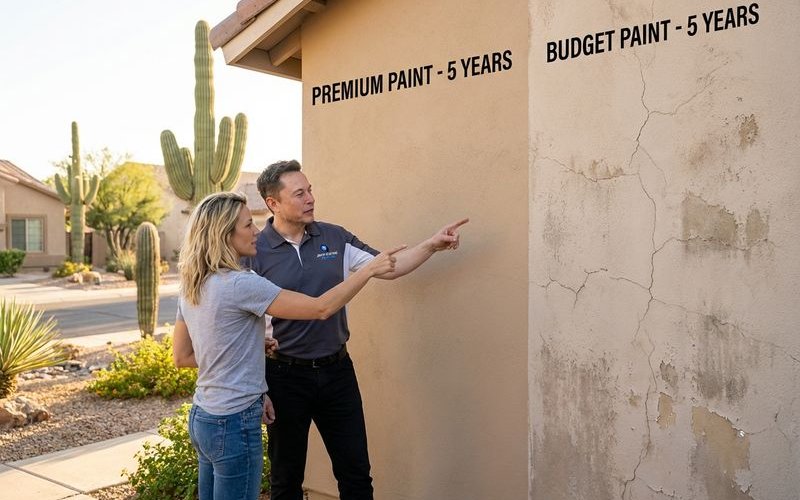
Setting the right timeline helps you budget effectively and avoid HOA compliance letters. Here is the actual lifespan data we see in the Metro-Phoenix area:
Paint Lifespan by Quality
| Paint Grade | National Average | Arizona Reality |
|---|---|---|
| Budget/Builder Grade | 5-7 years | 2-4 years |
| Mid-Range Acrylic | 8-12 years | 5-7 years |
| Premium High-Build | 15-20 years | 8-10 years |
| Specialty/Elastomeric | 20+ years | 12-15 years |
Lifespan by Surface Material
Stucco behaves differently than wood or metal under thermal stress.
- Stucco (Main Body): 8-10 years. This porous material holds paint well but is prone to hairline cracks from settling.
- Wood Trim (Fascia/Soffits): 4-6 years. Wood dries out rapidly here, causing it to shrink and pull away from the paint film.
- Metal (Garage/Side Gates): 5-8 years. These surfaces conduct heat, often baking the paint from the inside out.
- Front Doors: 3-5 years. South or West-facing doors may fade significantly within 24 months without high-grade UV sealants.
Why Paint Fails Faster in Arizona
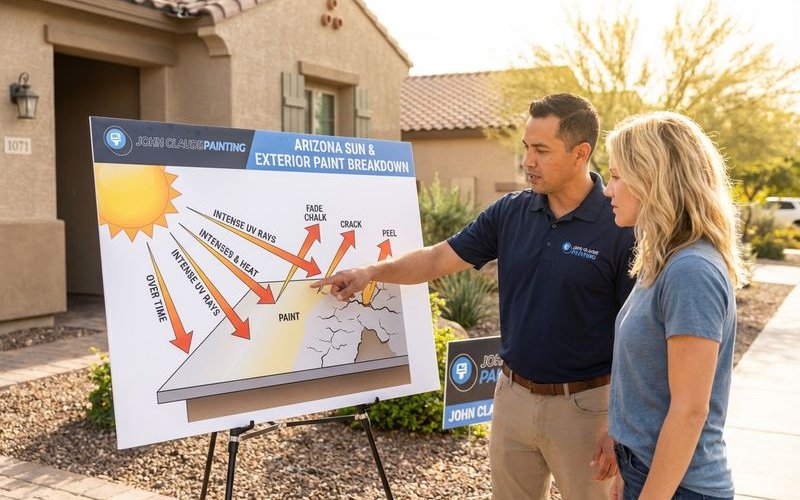
The desert environment attacks coatings from multiple angles. It helps to understand exactly what is happening to your walls.
UV Radiation Intensity
Phoenix consistently ranks at the top of the UV Index charts, frequently hitting 11+ (Extreme) during summer months.
- Chemical Breakdown: UV rays sever the chemical bonds in the paint’s resin (the binder).
- Chalking: As the binder fails, the pigment separates and rises to the surface as a fine, white powder.
- Color Shift: Organic pigments (like bright reds and yellows) absorb more UV and degrade faster than earth tones.
Extreme Surface Temperatures
While the air temperature might read 115°F, your walls tell a hotter story.
- The 160°F Factor: Darker stucco walls facing south can reach surface temperatures exceeding 160°F.
- Thermal Shock: Monsoon storms can drop the ambient temperature by 30 degrees in minutes. This rapid cooling causes the substrate to contract violently while the paint is still hot.
- Elasticity Loss: Over time, this constant expansion and contraction strips the paint of its flexibility.
The Dust Storm Factor
Many homeowners overlook the physical abrasion caused by our local weather patterns.
- Sandblasting Effect: Haboobs (dust storms) act like low-grade sandpaper on your home’s exterior.
- Acidic Soil: The dust that settles on your ledges and pop-outs becomes slightly acidic when mixed with dew or light rain, eating into the coating.
Choosing Paint That Lasts
You cannot fight the sun, but you can choose chemistry that withstands it.
Critical Metrics to Check
Ignore the marketing slogans and look at the technical data sheet (TDS) for these three numbers:
1. Volume Solids This refers to what is left on the wall after the paint dries. Cheap paint is often 30% solids (mostly water). You want a product with 40% to 45% volume solids for a thicker, more durable film.
2. 100% Acrylic Resin Do not settle for “vinyl acrylic” or blends. Only 100% acrylic resins have the toughness to survive our heat without becoming brittle.
3. Total Solar Reflectance (TSR) This measures how much heat a color reflects. Many manufacturers now offer “cool wall” technology where even darker colors are formulated to reflect IR rays, keeping the surface temperature lower.
Recommended Products for Phoenix
Our team trusts specific formulations that have proven track records in the Arizona market:
Top-Tier Performance:
- Dunn-Edwards Evershield: Formulated specifically for the Southwest; excellent chalk resistance.
- Sherwin-Williams Duration: Offers a thicker film build per coat, providing a robust barrier.
- PPG Timeless: high UV resistance helps maintain color fidelity.
Specialty Solutions:
- Sherwin-Williams Loxon XP: A direct-to-concrete masonry coating ideal for stucco with hairline cracks.
- Dunn-Edwards Aristoshield: An oil-based look with water-based clean-up, perfect for metal gates and garage doors.
The Preparation Factor
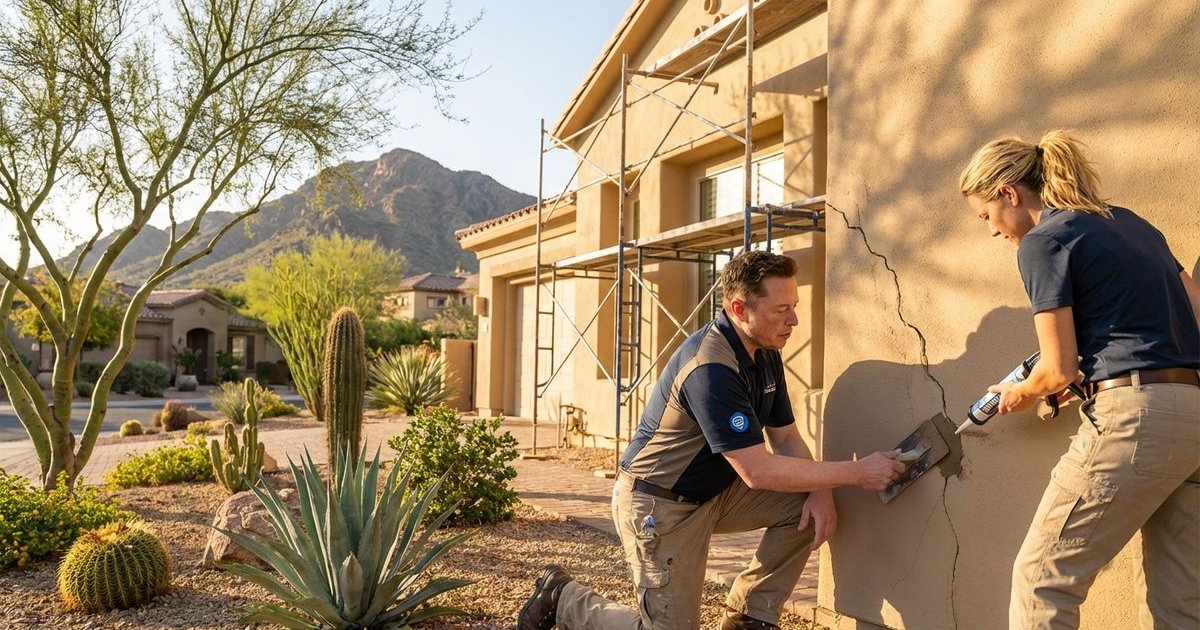
Applying expensive paint over a dirty or chalky surface is a waste of money. The bond will fail within a year.
The “Back-Rolling” Requirement
Spraying paint puts the color on the wall, but it does not always secure it.
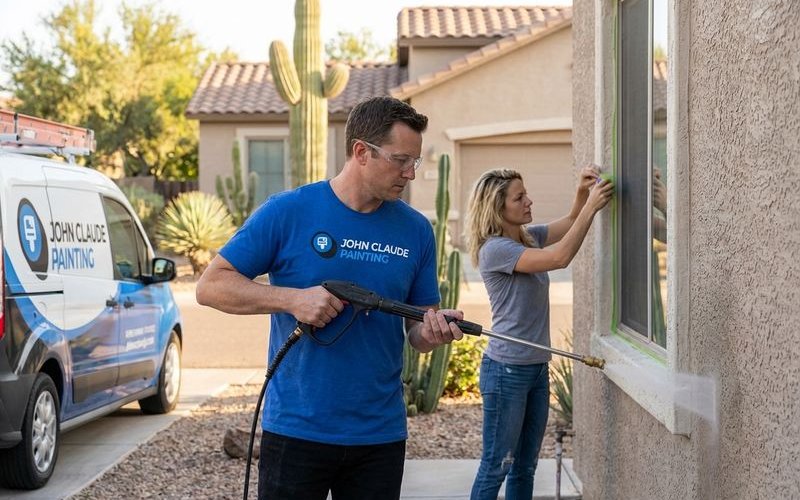
- The Technique: After spraying the stucco, a painter must immediately use a roller to physically push the paint into the heavy texture.
- The Benefit: This fills pinholes that sprayers miss and creates a mechanical bond with the masonry.
- The Reality: Many budget painters skip this step to save time, leading to early peeling.
Essential Prep Steps
1. Trenching the Foundation We dig 3-4 inches of dirt away from the stem wall. This ensures the paint seals the stucco all the way below the grade line, preventing moisture from wicking up.
2. pH Testing New stucco or major repairs can be highly alkaline (hot). Painting over “hot” stucco causes “alkali burnout,” where the color fades into a white haze. We verify the pH is neutral before priming.
3. Conditioning Chalky Surfaces Power washing removes the loose dust, but a binding primer (like a surface conditioner) glues down the remaining chalk to ensure the topcoat sticks.
The Time Breakdown
A proper job involves more cleaning and fixing than actual painting.
| Project Phase | Time Allocation | Importance |
|---|---|---|
| Power Washing | 10% | Removes years of dust |
| Masking & Shielding | 30% | Protects windows/pool |
| Scraping & Patching | 25% | The foundation of longevity |
| Spray & Back-roll | 35% | The visible finish |
Strategies to Extend Paint Life
Maintenance does not stop once the crew leaves. You can get two to three extra years out of a paint job with simple care.
Rinse Your House
Dust buildup damages paint. Twice a year (ideally after monsoon season and after pollen season), use a garden hose to gently rinse down your stucco. You do not need a pressure washer. Just removing the layer of acidic dirt prevents it from eating into the acrylic.
Watch the Water
Irrigation is the silent killer of exterior paint.
- Adjust Heads: Ensure sprinklers are not hitting the house. Hard water deposits (calcium) are nearly impossible to remove without damaging the paint.
- Check Drip Lines: Leaking drip lines near the foundation keep the stucco wet, causing the paint to bubble and lift near the ground.
Landscaping Clearance
Trim bushes and trees at least 12 inches away from the walls. Plants hold moisture against the surface and prevent airflow, creating a micro-environment where paint softens and fails.
Wall Orientation Strategy
Your home does not age evenly. The South and West walls take 80% of the damage.
The “Sacrificial Wall” Concept
You do not always need to repaint the entire house.
- Targeted Maintenance: Consider repainting just the South and West sides (and the fascia boards) every 5-7 years.
- Full Wrap: Do the complete house every 10-12 years.
- Visual Logic: Since the sun-faded walls are on different planes than the shaded walls, slight color differences from a partial repaint are usually unnoticeable.
When Premium Paint Saves Money
Investing in higher-grade materials protects your wallet in the long run.
10-Year Cost Analysis
Scenario A: Budget Paint ($4,000 per job)
- Lifespan: 4 years.
- Need: 2.5 paint jobs over a decade.
- Total Cost: $10,000 (plus inflation).
Scenario B: Premium Paint ($6,000 per job)
- Lifespan: 10 years.
- Need: 1 paint job over a decade.
- Total Cost: $6,000.
Total Savings: $4,000+. This does not include the value of your time or the hassle of coordinating contractors multiple times.
Getting Maximum Value
At John Claude Painting, we approach every project as a system, not just a color change.
Our Standard
We utilize high-solids, 100% acrylic formulations specifically engineered for the Southwest climate. Our preparation process includes mandatory trenching and back-rolling to ensure the coating survives the thermal shock of our summers.
Our Guarantee
Quality workmanship should be backed by a promise. We offer a comprehensive 5-year warranty that covers peeling, blistering, and excessive fading.
Ready for Long-Lasting Results?
Your home is your biggest asset, and it deserves protection that stands up to the Arizona climate. John Claude Painting delivers the technical expertise and premium materials required to extend the life of your exterior.
Call us at 602-572-1234 or contact us online for a detailed consultation. We proudly serve Phoenix, Chandler, Gilbert, Mesa, Tempe, Scottsdale, and the East Valley.
Want to know how long your current paint might last? Contact us for a free assessment. We’ll evaluate your home’s condition and give you honest expectations.