The Art and Science of Choosing Paint Colors
You know that feeling when you walk into a model home in Gilbert or a renovated ranch in Ahwatukee and the space just feels balanced? It usually isn’t the furniture that creates that harmony. The secret ingredient is almost always the color selection.
At John Claude Painting, we have seen firsthand through our interior painting projects how the right shade can make a room feel ten degrees cooler during a Phoenix summer. We’ve also seen how the wrong undertone can turn a beautiful living room muddy the second the sun hits the Superstition Mountains.
Selecting paint colors for your Phoenix home is about more than just picking a pretty swatch. You have to account for the intensity of the Sonoran Desert sun and the specific architecture of our region.
We are going to break down the science of light, the data behind color selection, and the practical steps to getting it right the first time.
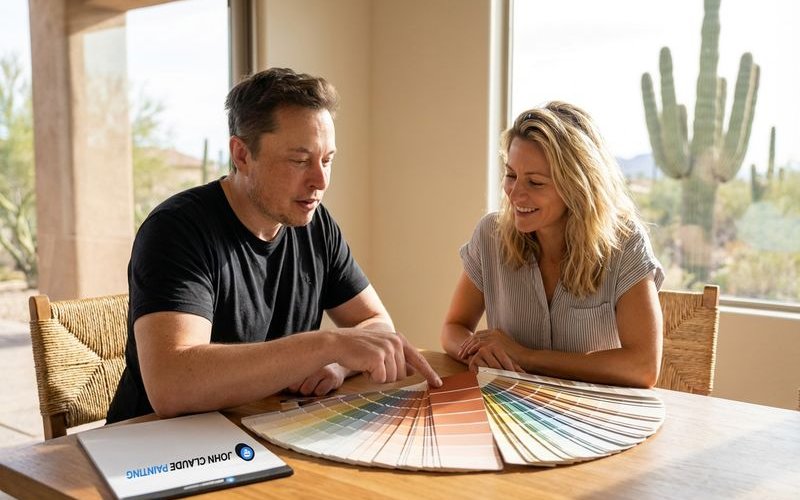
Understanding Arizona Light
Before you buy a single sample pot, you must respect the physics of light in the Valley. Arizona sunlight is measurably different from the light in the Midwest or Pacific Northwest.
The Kelvin Temperature Factor
Natural daylight in Phoenix often hits a color temperature of 5000K to 6500K during midday. This cool, blue-heavy light has a specific effect on pigment:
- It neutralizes warm tones. A creamy yellow that looks subtle in a store might look stark white in your south-facing kitchen.
- It amplifies cool tones. A light gray with blue undertones can turn instantly icy or “baby blue” when exposed to our midday sun.
The “Golden Hour” Shift
Arizona sunsets are famous for a reason. Between 5:00 PM and 7:00 PM, the light temperature drops rapidly to 2000K-3000K.
- Warm tones glow. Terracottas and warm whites become incredibly rich during this window.
- Cool grays flatten. Without warm artificial lighting to counter it, cool grays can look flat or greenish as the sun goes down.
Room Orientation and Light Reflectance Value (LRV)
The most overlooked data point on a paint chip is the LRV. This number, running from 0 (black) to 100 (white), tells you how much light a color reflects. In Phoenix, this matters for both heat management and aesthetics.
| Direction | Light Quality | Recommended LRV Range | Best Color Families |
|---|---|---|---|
| North | Cool, indirect, consistent shadow | 50-70 (High Reflectance) | Warm whites, soft creams, beige (Avoid cool grays) |
| South | Intense, direct, hot light | 40-60 (Medium Reflectance) | Cool neutrals, blues, greens (Can handle dark saturation) |
| East | Bright morning, dim afternoon | 50-65 (Medium-High) | Warm grays, pigmented whites |
| West | Hazy morning, scorching afternoon | 45-60 (Medium) | Earth tones, sage greens (Avoid red/orange which intensifies heat) |
The Psychology of Color in Your Home
Colors do more than cover drywall. They dictate the energy of your household.
Calming Retreats
We often recommend cooling palettes for bedrooms to psychologically counter the outdoor heat.
- Sherwin-Williams Sea Salt (SW 6204): A fluid green-gray that feels like a spa.
- Benjamin Moore Palladian Blue (HC-144): A soft blue-green that lowers the visual temperature of a room.
- Warm Neutrals: These provide a “cocoon” effect without trapping heat visually.
Energizing Spaces
Kitchens and home offices in Chandler and Gilbert are moving away from stark whites toward personality-driven hues.
- Ochre and Gold: These tones mimic the desert sunrise and stimulate conversation.
- Terracotta: A sophisticated nod to Saltillo tile that feels grounded and energetic.
- Crisp Whites: We prefer whites with a slight gray undertone for offices to maintain focus.
Sophisticated Gathering Spots
For dining and living rooms, deep colors are making a massive comeback in luxury Phoenix homes.
- Charcoal and Iron: These create a modern, gallery-like backdrop for art.
- Forest Green: This color pairs exceptionally well with the leather furniture and wood tones common in Southwest decor.
- Navy Blue: A classic anchor color that works comfortably in both modern and traditional styles.
Popular Color Trends for Phoenix Homes
Design in the Valley has shifted. The heavy “Tuscan” trend of the early 2000s has evolved into “Organic Modern” and “Desert Contemporary.”
The New Neutrals (Beyond Beige)
Homeowners are trading yellow-based beiges for complex greiges and warm whites.
- Sherwin-Williams Alabaster (SW 7008): A warm, soft white that doesn’t look yellow. It is the go-to for trims and walls in open-concept homes.
- Benjamin Moore Edgecomb Gray (HC-173): An organic neutral that bridges the gap between beige and gray.
- Sherwin-Williams Accessible Beige (SW 7036): This remains a staple because it works with both warm travertine floors and cool luxury vinyl plank (LVP).
Desert-Inspired Palettes
We are seeing a surge in colors that pull directly from the Sonoran landscape.
- Redend Point (SW 9081): A soulful blush-beige that looks like desert sand at dusk.
- Evergreen Fog (SW 9130): A versatile green-gray that complements cactus and agave landscaping.
- Cavern Clay (SW 7701): An earthy hue that brings the outdoors in without feeling dated.
Modern Application Techniques
Color isn’t just about the wall anymore. The placement is changing.
- The “Color Drench”: Painting baseboards, walls, and crown molding the same color but in different sheens.
- Dark Ceilings: In rooms with high ceilings (10ft+), a dark charcoal ceiling can make the space feel intimate rather than cavernous.
- Contrasting Doors: Interior doors painted in Iron Ore or Tricorn Black against white walls create instant custom-home appeal.
Common Color Selection Mistakes
We fix a lot of DIY paint jobs. Usually, the application is fine, but the color theory failed.
Mistake 1: The “Store Light” Trap
Florescent retail lighting has a Color Rendering Index (CRI) of about 60-70. Sunlight is 100.
The Fix: Never trust the color you see in the store. You must view the pigment in your specific home environment.
Mistake 2: Ignoring the “Dust Factor”
Phoenix is dusty. We all know it.
The Fix: Avoid “Flat” or “Matte” paints in high-traffic areas. While they hide drywall imperfections, they hold onto dust and are impossible to wipe down. We recommend a high-quality Matte or Velvet sheen that is formulated to be washable, or a classic Satin for durability.
Mistake 3: Fighting Your Fixed Elements
You cannot ignore your flooring. If you have honey-oak cabinets or pink-undertone travertine floors (common in 2005-era builds), a cool gray wall paint will clash violently.
The Fix: Identify the undertone of your fixed elements first. If your floor is warm, your paint must have a warm undertone to harmonize.
Mistake 4: Isolate-Viewing
Viewing a color strip against a white wall tricks your eye.
The Fix: Compare your sample against your furniture and flooring, not just the existing wall color.
A Step-by-Step Color Selection Process
Follow this protocol to eliminate buyer’s remorse.
Step 1: Digital Discovery
- Create a dedicated Pinterest board for each room.
- Look for rooms with similar flooring to yours.
- Identify the recurring themes (e.g., “Oh, I keep pinning dark green offices”).
Step 2: The Physical Audit
- Stand in the center of the room.
- Note the window direction (N, S, E, W).
- Identify the dominant colors in your furniture and rugs.
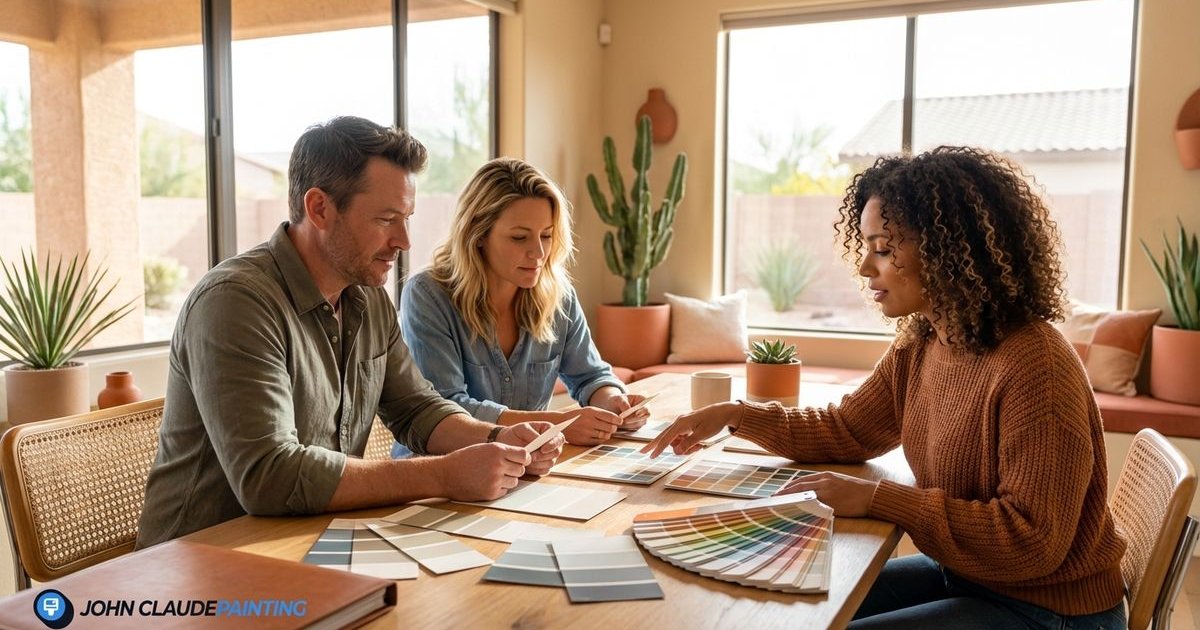
Step 3: The Sample Phase (The Right Way)
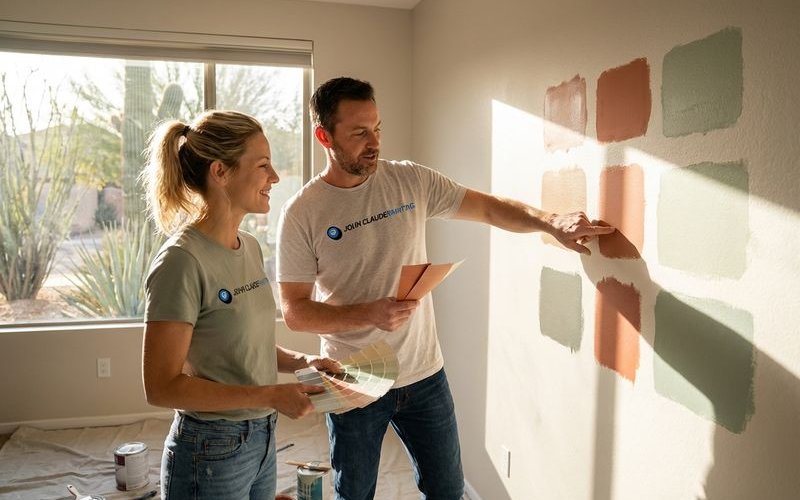
- Do not paint the wall directly. The existing color will bleed through and distort the sample.
- Use Peel-and-Stick or Poster Board. Paint a large 2x2 poster board or order large peel-and-stick samples (like Samplize).
- Move it around. distinct walls receive light differently.
Step 4: The 24-Hour Test
- Check the color at 8:00 AM (Morning light).
- Check the color at 2:00 PM (Harsh overhead light).
- Check the color at 8:00 PM (Artificial light).
Step 5: Final Verification
- Check the color against your trim.
- Ensure it flows with the adjacent room.
- Make your final decision based on the time of day you use the room most.
Creating Color Flow Throughout Your Home
Flow is what separates a custom look from a choppy one.
The 60-30-10 Rule
This classic design formula works for a reason.
- 60% (The Canvas): The main wall color.
- 30% (The Foundation): Upholstery, rugs, and curtains.
- 10% (The Jewelry): Pillows, art, and accessories.
Connected Spaces
Open floor plans in Gilbert and Chandler require a cohesive strategy. You don’t need to paint the whole house one color, but the colors must “talk” to each other.
- Use the same temperature. Keep all rooms warm or all rooms cool.
- Vary the saturation. Use a light version of a color in the living room and a darker version of that same shade in the dining nook.
Don’t Forget the Fifth Wall
Ceilings are a massive surface area.
- White: Lifts the ceiling, feels airy.
- Wall Color at 50%: Creating a custom mix of your wall color (diluted with white) for the ceiling creates a seamless, high-end transition.
- Contrast: A soft blue ceiling in a neutral room mimics the sky.
Working With a Professional
A color consultation is an investment in satisfaction.
Why Go Pro?
Professional painters see how colors age and react to light over years, not just days.
- Technical Knowledge: We know which bases cover well and which sheer colors might need three coats.
- Local Expertise: We understand which products hold up best to Arizona’s dry heat and UV exposure.
- Objective Advice: We aren’t emotionally attached to your old sofa, so we can give you honest feedback on what matches.
Our Approach
At John Claude Painting, we treat your home as a system. Our consultation covers:
- Measuring Light Reflectance Values in your specific rooms.
- Matching undertones to your permanent fixtures.
- Creating a “Whole Home” palette that flows from the front door to the back patio.
Ready to Transform Your Space?
Choosing the right colors is the first step to a home you love. At John Claude Painting, we combine color expertise with flawless application to create beautiful results.
Contact us at 602-572-1234 or schedule a consultation to discuss your interior painting project. We serve Phoenix, Chandler, Gilbert, Mesa, Tempe, Scottsdale, and surrounding areas.
Need help choosing colors? Our color consultation service takes the guesswork out of your painting project. Ask about including color consultation with your painting estimate.