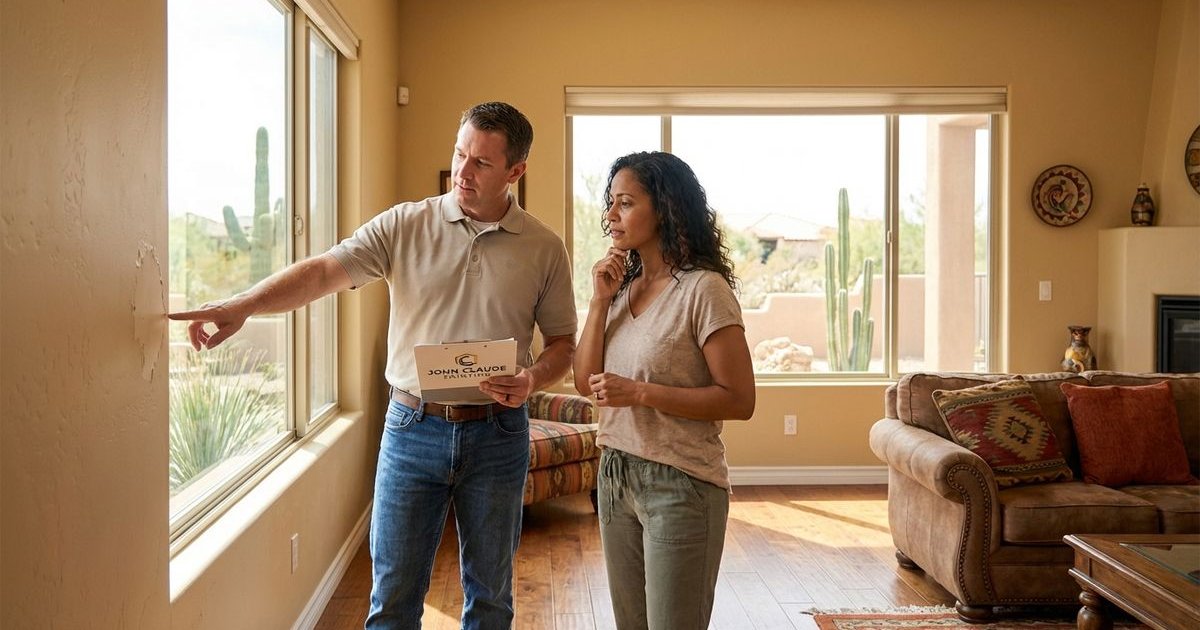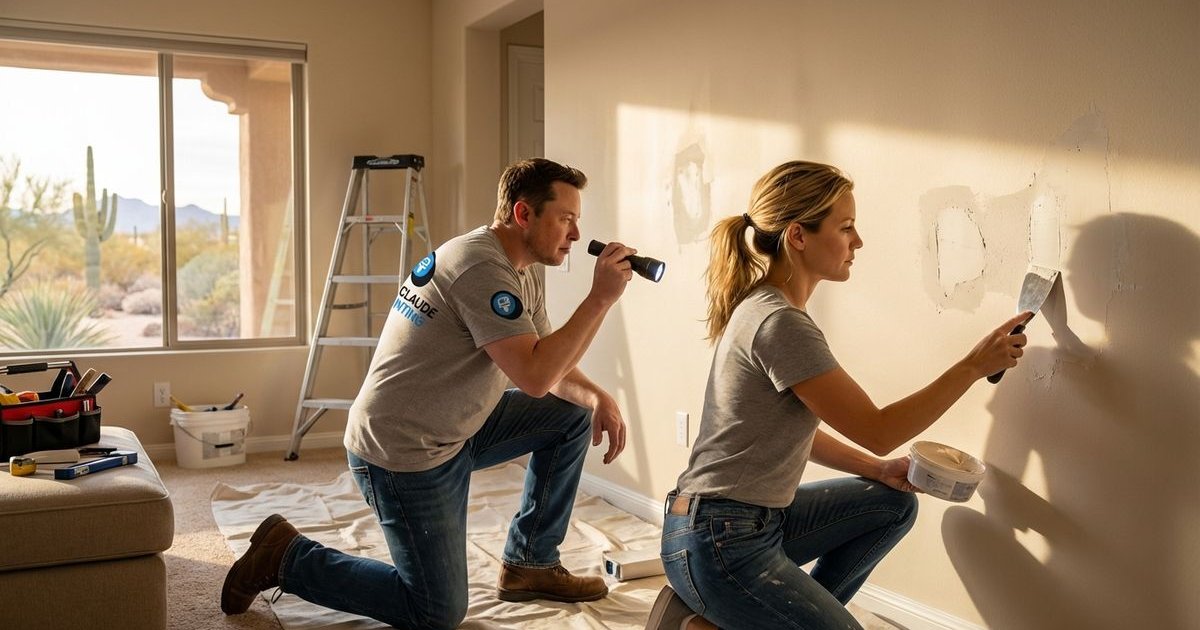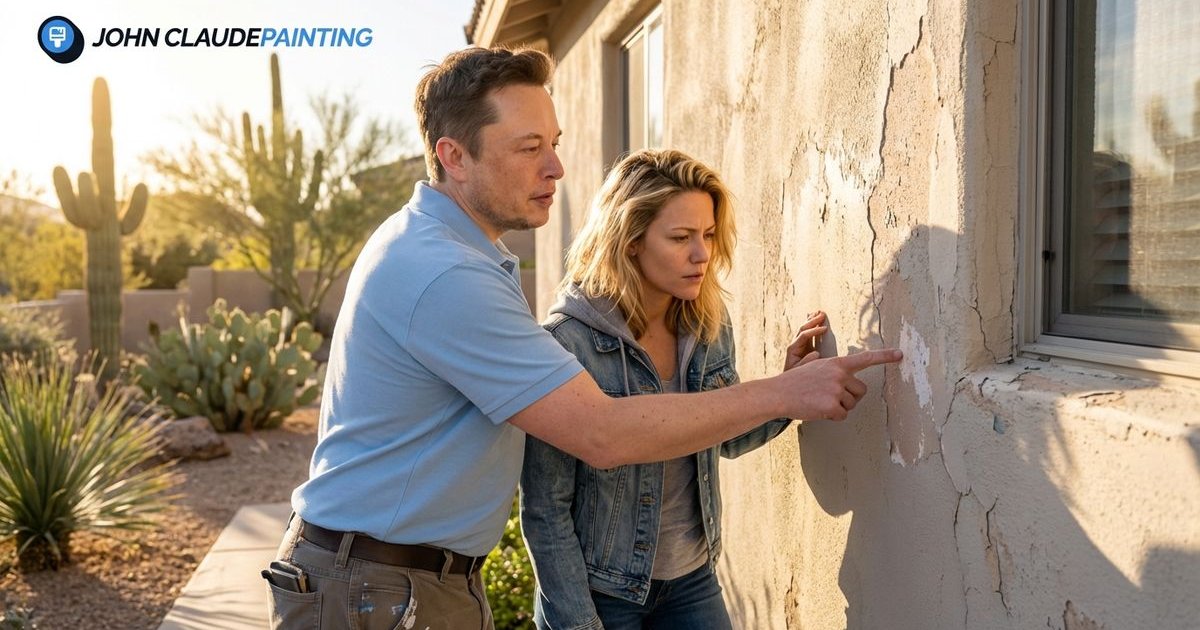
Is Your Home Telling You It Needs Paint?
Your home’s exterior paint does much more than look good. It serves as the primary shield protecting your largest investment from the harsh Sonoran Desert climate. Knowing exactly when to repaint can save you thousands in stucco repairs and help maintain your property value.
At John Claude Painting, we evaluate hundreds of homes across Phoenix, Chandler, and Gilbert every year for our exterior painting service.
Our team has seen firsthand how the intense Arizona sun breaks down exterior coatings faster than almost anywhere else in the country. Here are the seven telltale signs that your home is ready for professional attention.
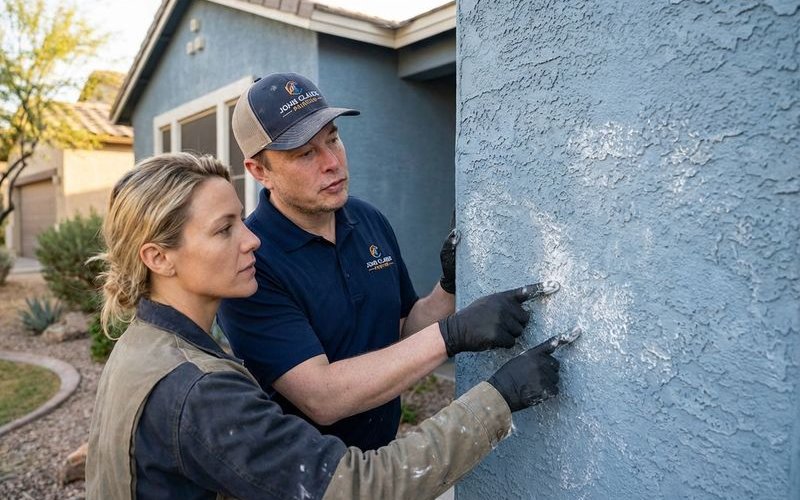
Sign 1: Chalking
Chalking is easily the most common early warning sign we see in the Valley. If you run your hand across your exterior wall and it comes away with a white or colored powdery residue, that is chalking.
What Causes Chalking
This happens because the resin binder in the paint is breaking down.
- Intense UV exposure: The sun destroys the plastic-like bond holding the pigment.
- Pigment release: As the binder fails, the color particles sit loose on the surface.
- Heat acceleration: Surface temperatures on stucco can hit 160°F, speeding up this chemical degradation.
- Material quality: Lower-grade paints with less acrylic resin will chalk much sooner.
Why It Matters
You might think this is just a cosmetic annoyance. It is actually a sign that your waterproofing layer is gone.
- Protection loss: The paint is no longer sealing the stucco against moisture.
- Adhesion issues: New paint cannot stick to a chalky surface without serious preparation.
- Messy transfer: The powder stains clothes and anything else that brushes against the house.
The Fix
We address this issue with a rigorous cleaning process.
- Pressure washing: We remove the loose oxidation carefully to reach a sound surface.
- Conditioning primer: A specialized masonry conditioner binds any remaining dust.
- 100% Acrylic topcoat: High-quality paint resists future breakdown longer.
Sign 2: Fading
While some gradual lightening is normal over a decade, dramatic color loss indicates the paint film is failing.
Normal vs. Problem Fading
Understanding the difference helps you decide if it is an emergency or just natural aging.
| Feature | Normal Aging | Paint Failure |
|---|---|---|
| Timeline | Gradual over 5-10 years | Rapid shift in 2-3 years |
| Appearance | Uniform lightening | Patchy, uneven spots |
| Protection | Film is intact | Film is thinning or porous |
| Surface | Smooth to touch | Rough or brittle feel |
Why Arizona Fading Is Worse
Phoenix consistently ranks near the top of the Global Solar UV Index. Paint that might last 12 years in the Midwest often starts showing fatigue here in just 5 to 7 years.
West-Facing Walls
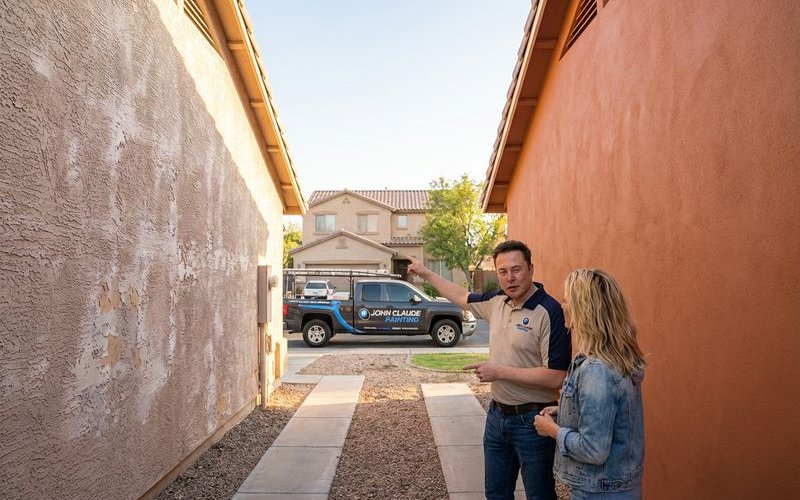
You should always inspect the west side of your property first.
- Solar abuse: These walls take the punishing afternoon sun when ambient temperatures are highest.
- Accelerated wear: We often see West walls fade 2 to 3 times faster than North walls.
- HOA notices: In neighborhoods like Ahwatukee, inconsistent fading on one side is a common trigger for HOA violation letters.
Sign 3: Peeling, Cracking, or Flaking
When paint loses its grip, it separates from the wall. This is a critical failure because it leaves the raw building material exposed to the elements.
Causes in Arizona
Improper preparation: Paint applied over dusty or chalky surfaces will eventually let go.
- Rushed cleaning: Skipping the pressure wash is a fatal error.
- Cheap primer: Using low-grade sealers leads to bond failure.
Thermal Shock: Our desert climate sees massive temperature swings.
- Daily expansion: Materials expand in the 110°F day and contract in the 85°F night.
- Shear stress: Over time, paint loses its elasticity and snaps under this movement.
Moisture issues: Water trapped behind the paint pushes it off the wall.
- Sprinkler errors: Irrigation hitting the house is a leading cause of localized peeling.
- Window leaks: Poor sealing around frames allows water to travel behind the stucco.
Why You Can’t Ignore It
Ignoring peeling paint is a fast track to expensive stucco repairs.
- Water infiltration: Rain and landscape water soak into the raw stucco.
- Structural decay: The metal lath behind the stucco can rust and expand.
- Compounding costs: A simple repaint turns into a masonry reconstruction project.
Sign 4: Stucco Cracks and Damage
Stucco cracks are structural concerns that often reveal themselves through the paint.
Types of Stucco Cracks
Hairline cracks: These are very common and usually caused by normal settling.
- Size: Generally less than 1/16th of an inch wide (thinner than a dime).
- Fix: We bridge these easily with high-quality elastomeric paint.
Spider web cracks: You will see a network of small, intersecting lines.
- Cause: Often due to the original mix drying too fast or improper hydration.
- Action: These require a thorough evaluation to ensure the stucco is still bonded to the lath.
Structural cracks: Any crack wider than a credit card (1/8 inch) is a major concern.
- Risk: These allow significant water entry and suggest foundation movement.
- Repair: Professional masonry patching is required before any painting begins.
Arizona-Specific Issues
Our extreme thermal cycles are tough on rigid masonry.
- Expansion joints: Many older homes lack sufficient expansion joints to handle the movement.
- Monsoon impact: Driving rain seeks out these cracks, leading to internal wall damage.
Sign 5: Visible Stains and Discoloration
Stains on your exterior are rarely just surface dirt. They are usually evidence of an ongoing interaction between your home and the environment.
Common Stain Types
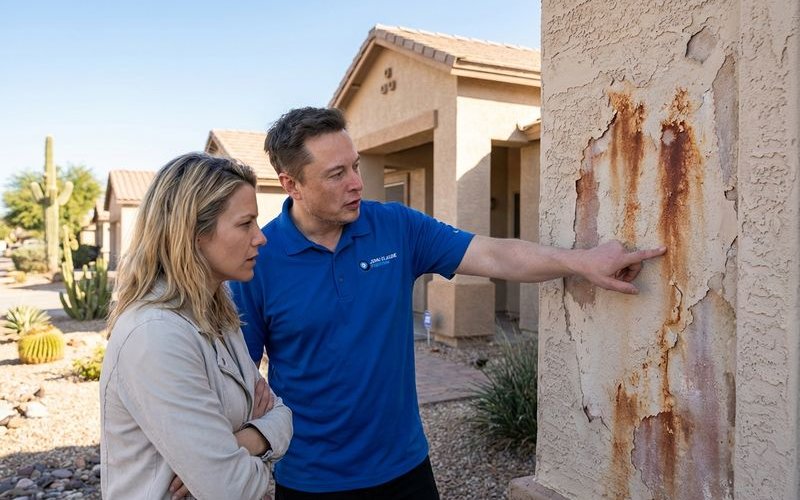
Rust stains: Orange streaks often run down from metal fixtures.
- Sources: Ungalvanized nails, old light fixtures, or decorative ironwork.
- Solution: We treat the source with a rust inhibitor before painting.
Water stains: White deposits or dark streaks indicate chronic water contact.
- Efflorescence: White, salty powder appears where water moves through masonry.
- Hard water: Sprinklers hitting the house leave calcium deposits that are very hard to remove.
Mold and mildew: While rare in our dry air, this happens in shaded areas.
- Locations: North-facing eaves or behind dense vegetation.
- Treatment: A bleach solution wash is necessary to kill the spores before repainting.
Dirt accumulation: Textured stucco holds onto dust from haboobs and storms.
- Aesthetics: This makes the house look tired and aged.
- Hidden damage: Thick dirt layers can trap moisture against the wall.
Sign 6: Color Inconsistency
When your home looks like a patchwork quilt of different shades, it is time to repaint.
Causes of Inconsistency
Uneven Sun Exposure: The sun bleaches color differently depending on the angle.
- South/West: These walls lose vibrancy first.
- North/East: These areas may retain color for years longer.
- Result: The house loses its unified curb appeal.
Previous Touch-ups: Spot painting rarely matches perfectly after a few months.
- Batch variance: Paint formulas change slightly over time.
- Sheen difference: New paint has a higher sheen than weathered paint.
- Fading gap: The old paint continues to fade while the patch stays fresh.
Application Errors: You can sometimes see “striping” from poor spray technique.
- Thin coverage: The underlying stucco color bleeds through as the topcoat thins.
- Inconsistent overlap: Darker vertical lines appear where the sprayer overlapped too heavily.
Sign 7: Caulking Failure
While not technically paint, caulking is a vital part of your exterior waterproofing system.
Signs of Caulking Failure
We check every seam around windows, doors, and trim.
- Cracking: The bead of caulk has split down the middle.
- Separation: The caulk has pulled away from the stucco or the window frame.
- Hardness: Flexible caulk has turned brittle and hard.
Why It Matters
Failed caulk is an open door for energy loss and water damage.
- Energy bills: Conditioned air escapes through these gaps.
- Pest entry: Small gaps are highways for ants and scorpions.
- Water intrusion: Rainwater funnels behind the stucco, rotting the wood framing.
Part of a Complete Paint Job
Professional painting is about 40% preparation and 60% application.
- Removal: We cut out old, failed sealants.
- Selection: We use high-performance urethane or elastomeric caulks that stretch.
- Integration: Painting over the caulk adds a final layer of UV protection.
How Arizona Accelerates Paint Failure
Understanding the science helps you see why quality matters.
The Arizona Trifecta
1. UV Radiation
- Intensity: Arizona receives over 3,800 hours of sunshine annually.
- Effect: UV rays act like a laser, breaking the chemical bonds in the paint resin.
2. Extreme Heat
- Surface Temps: Dark stucco can reach 160°F or higher in July.
- Impact: Heat softens the coating, making it hold onto dirt, while also baking out the plasticizers that keep it flexible.
3. Rapid Temperature Changes
- Thermal Shock: A monsoon storm can drop the surface temperature by 50 degrees in minutes.
- Result: This rapid contraction causes microscopic fractures that grow over time.
What to Do If You See These Signs
If you notice any of these warning signs, taking action now is smarter than waiting.
Immediate Steps
- Document the issues: Walk your perimeter and take photos of cracks, peeling, or fading.
- Note locations: Identify which walls are affected (West and South are usually first).
- Check for moisture: Ensure no sprinklers are actively soaking your walls.
- Get professional evaluation: A trained eye can spot the difference between cosmetic aging and structural risk.
Don’t Wait
Delaying exterior painting often leads to “stucco cancer.”
- Higher costs: Patching damaged stucco costs significantly more than just painting.
- Interior risk: Once the exterior seal is broken, your drywall and insulation are at risk.
- Value drop: Curb appeal is the primary driver of home value in competitive markets like Gilbert and Chandler.
Free Exterior Assessment
Not sure if your home needs painting? We offer free exterior evaluations throughout the Phoenix area.
Our experts will honestly assess your home’s condition and tell you:
- Whether you need to paint now.
- If you can wait another year or two.
- What specific repairs are required.
- Exactly what the project would cost.
Call us at 602-572-1234 or schedule a free assessment today. We serve Phoenix, Chandler, Gilbert, Mesa, Tempe, Scottsdale, and the East Valley.
Concerned about your home’s exterior? Don’t wait until small problems become expensive repairs. Contact John Claude Painting for an honest evaluation of your home’s painting needs.